
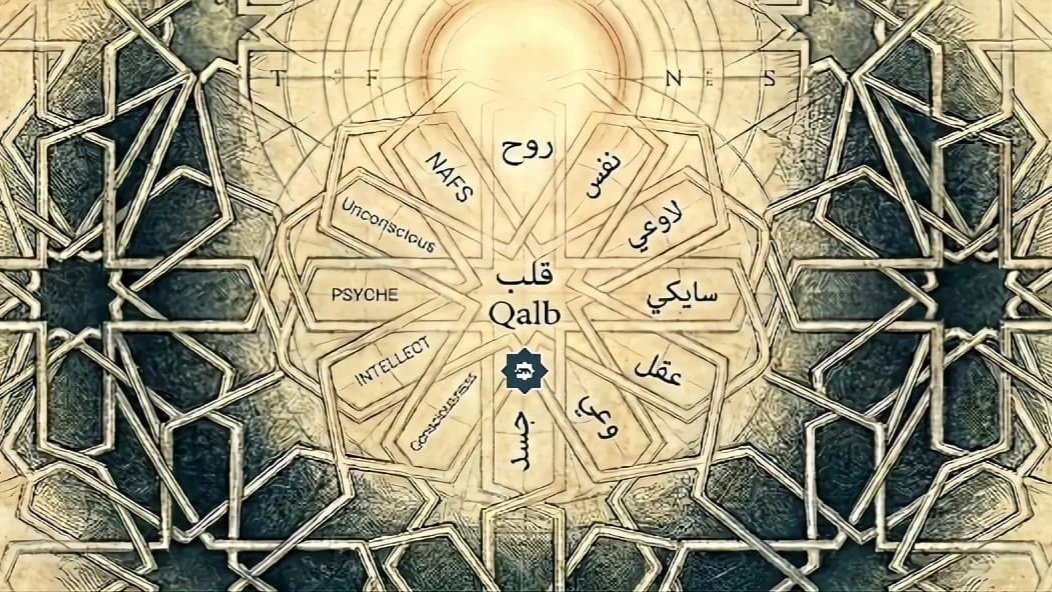
Nafsychology™
Refinement in Proportion
Nafsychology is an educational, ethics-first project for psycho-spiritual refinement, using psychological typology as map-language under Islamic guardrails.
_________
Educational only. No tests, scores, or authoritative typing. No diagnosis or therapy. No Fatwā.


Defining Nafsychology
A structured synthesis for the refinement of the Nafs
Nafsychology (pronounced /næfˈsaɪ.kɑː.lə.dʒi/) uses psychological typology as descriptive map-language under Islamic ethical and theological guardrails, oriented toward proportion and refinement. Revelation remains the higher measure. Psychological models remain provisional tools for naming patterns of attention and one-sidedness without turning a map into a verdict.
Built on primary sources, not pop-psychology slogans.
Designed for proportionate refinement, not authoritative personality “typing.”
Guardrailed and educational by design, offering vocabulary rather than diagnosis or verdict.
Offered as an open synthesis with humility, built for critique and future stewardship.
Three paths in
Path 1: Start Here
A beginner's overview of the project, scope, and reading order.
Path 2: Library
Refinement Notes and Core Explainers: practice essays and evergreen foundations under one consistent lens.
Path 3: Professionals & Scholars
Claims, limits, sources discipline, and citation guidance.
Maps and compass
How Nafsychology positions itself
Nafsychology treats psychological models as provisional maps for recurring patterns in the inner life: useful in proportion, and dangerous in excess. Because these models cannot define the Nafs or function as revealed categories, they require a disciplined starting point. This necessary limit is why the work begins by carefully clarifying Jungian typology, with restraint.
Resonances may be noted as limited analogies, but typological constructs are never equated with the measure of revelation. The result is not a catalog of personality labels, but a living map of refinement: language for self-observation, growth toward balance, and steadier moral clarity.
→ For Professionals & Scholars: claims, limits, and citation guidance.
“Strength without proportion becomes a trap; proportion turns strength into craft.”
What Nafsychology is… and is not
Nafsychology is
An educational, ethics-first project for psycho-spiritual refinement, using psychological typology as map-language under Islamic guardrails
A structured synthesis held under clear guardrails
A framework for proportionate self-observation and refinement in everyday life
An emerging contribution, open to critique and improvement
Nafsychology is not
A test, assessment, certification, or diagnostic instrument
Therapy, crisis care, or clinical protocol
Fatwā, or a substitute for qualified religious guidance
A catalog of “types” used to force a label on people, excuse conduct, or perform identity
Scope: Educational framework only.
The current work:
The Nafsychology Foundation Sequence
The first public expression of Nafsychology is now a structured three-book foundation for psycho-spiritual refinement under Islamic guardrails.
Book One establishes the working psychological map: Jungian typology clarified with disciplined sources, a structured synthesis, and practical paths of refinement.
Book Two deepens the psychological foundation through a more demanding account of hidden counterbalance and structural synthesis, while remaining under the project’s guardrails.
Book Three foregrounds the spiritual faculties under authentic revelation as the higher measure, while keeping psychological language disciplined and in service rather than in rule.
Books One and Two establish the psychological foundation. Book Three carries the psycho-spiritual turn.
Book One (nearest to publication)
The Art of Nafsychology™
A Guided Journey Through Jungian Typology Under Islamic Guardrails
Book One brings typological map-language into day-to-day refinement without turning it into a cage. It prioritizes disciplined sources, clear boundaries, and usable language for proportion, avoiding pop-typology shortcuts and test-culture incentives.
Book Two (in development*)
The Art of Nafsychology™
Book Two deepens the psychological foundation at a high level only, without previewing its fuller internal architecture online.
Book Three (in development*)
The Art of Nafsychology™
Book Three foregrounds the spiritual faculties under authentic revelation while keeping psychological language disciplined and in a supporting role.
* Details will be shared only when the structure has been tested with scholars and practitioners.
The Art of Nafsychology™ is the shared title across the three-book Nafsychology Foundation Sequence.
Why this matters
Nafsychology arises from a real need: psychological typology can name recurring patterns with useful precision, yet without measured guardrails it is easily flattened into labels, excuses, misplaced certainty, or the importation of false metaphysical assumptions into spiritual discourse.
The work on the Nafs in the Islamic tradition is deep, but a shared typological map-language for describing one-sidedness, tradeoffs, recurring pressures, and their disciplined refinement remains fragmented and contested.
Popular typology culture often names patterns without accountability. Many models describe tendencies without showing how conduct can be returned to proportion over time. And even serious psychological systems, when left without theological guardrails, can drift beyond description into assumptions they are not qualified to govern.
Nafsychology does not try to merge these domains into a single vocabulary. It uses psychological typology as descriptive map-language under Islamic guardrails, so refinement remains accountable to a higher measure.
The aim is not to resolve every tension, but to hold what is useful in disciplined proportion.
Who this work is for
Serious lay readers
Thoughtful Muslims and non-Muslims who want careful psycho-spiritual typology language, without trivia, identity theater, and forced profiles.
Typology-curious readers
Readers interested in typology who want sourced, usable insights oriented toward proportion and lived refinement, without pop-test culture.
Professionals and scholars
Researchers, clinicians, educators, students, and Muslim scholars or community leaders who are curious about typology but cautious about metaphysics, ethics, and scope. Those who want lane-keeping clarity, claims and non-claims, and citation guidance.
Readers tired of “Which character are you?” quizzes, yet unwilling to abandon careful maps of the inner life, will recognize the intent of this work.
The governing concern: refinement of the Nafs
The work of Nafsychology begins with a necessary distinction. Human beings are addressed by revelation and confronted by recurring patterns within the inner world. We must navigate both domains with strict proportion. Revelation speaks with absolute divine authority, while psychology speaks through observation, experience, and fallible theory. The former remains the higher measure, and the latter serves as a descriptive map.
The Noble Qur’an speaks of the Nafs in language of proportion, discernment, refinement, and consequence:
وَنَفْسٍۢ وَمَا سَوَّىٰهَا
فَأَلْهَمَهَا فُجُورَهَا وَتَقْوَىٰهَا
قَدْ أَفْلَحَ مَن زَكَّىٰهَا
وَقَدْ خَابَ مَن دَسَّىٰهَا
— Arabic: Sūrat Ash-Shams, Ayāt 7–10 | (91:7–10) | سُورَةُ الشَّمْس، الْآيَات ٧–١٠
And [by] the Nafs and ˹the One˺ who proportioned it [i.e., formed and fashioned it]. Then inspired it ˹with discernment of˺ its own rebellion and God-consciousness. Successful indeed is the one who refines it [i.e., purifies and elevates it]. And utterly ruined is the one who has entombed it [i.e., the one who has secretly corrupted and buried it]. (The Noble Qur’an, Sūrat Ash-Shams (91) 7–10, Nafsychology rendering.)
This passage is not used here to turn typology into revelation, nor to claim that psychological constructs are revealed categories. It establishes the higher concern that governs the project: the Nafs is not merely to be described; it is to be refined.
That is why Nafsychology treats psychological typology as map-language only. A map may help name recurring patterns, one-sidedness, and pressure. It may help a person notice where strength has lost proportion. But the measure of refinement does not come from the map. It remains answerable to revelation.
In this order, psychological language can be useful without becoming sovereign: it describes patterns, supports self-observation, and helps conduct return to proportion, while the Noble Qur’an and authentic Sunnah remain the higher measure for value, accountability, and Tazkiyat al-Nafs.
-
Once the hierarchy is clear, the psychological question becomes narrower: what kind of map can responsibly support self-observation without becoming a verdict?
Not every psychological model can bear that task. The map must clarify patterns without becoming a verdict. It must be structured enough to organize recurring patterns across time, not merely collect impressions. It must be modest enough to remain answerable to revelation, and disciplined enough to resist becoming a private language for self-justification.
This is why structure matters. Without a stable map, inner observation can become a private assortment of impressions: useful at times, but easily shaped by mood, preference, fear, or self-protection. A responsible typology does not solve the work of refinement. It gives that work clearer language.
Within that narrow task, Jungian typology is a logical starting point. Not because it is complete, supreme, or spiritually authoritative, but because it offers an internally structured language for observing conscious orientation, one-sidedness, compensation, and recurring tensions in the psyche.
Jung is therefore used here within a limited scope. His typological work functions as a psychological anchor: a way of organizing observations about familiar strengths, overlooked signals, and the patterns that emerge when one psychological orientation, or side of the personality, becomes overdeveloped or insufficiently examined.
The aim is not to define the Nafs, force equivalence with Islamic categories, or declare a verdict on the person’s inner world. The aim is to give self-observation a disciplined vocabulary, so reflection does not collapse into arbitrary opinion and psychological language does not become sovereign.
That limited use is why Jung’s own wording matters here. The passage below is not quoted to elevate Jung into a governing authority, but to show the practical function for which his typological work is being used: to discipline observation, organize psychological diversity, and resist arbitrary interpretation.
“The typological system I have proposed is an attempt, grounded on practical experience, to provide an explanatory basis and theoretical framework for the boundless diversity that has hitherto prevailed in the formation of psychological concepts. In a science as young as psychology, limiting definitions will sooner or later become an unavoidable necessity. Some day psychologists will have to agree upon certain basic principles secure from arbitrary interpretation if psychology is not to remain an unscientific and fortuitous conglomeration of individual opinions.” (Jung, 1921/1976, para. 987)
Read under Islamic guardrails, this supports only a limited claim: typology can help stabilize vocabulary for observing psychological patterns. It does not define the Nafs, establish the aim of Tazkiyat al-Nafs, or govern value and accountability. The map serves refinement only while it remains a servant map under revelation.
APA reference (1976 corrected paperback printing):
Jung, C. G. (1976). Psychological types (R. F. C. Hull, Rev. of H. G. Baynes’ trans.; H. Read, M. Fordham, G. Adler, & W. McGuire, Eds.; Vol. 6, The collected works of C. G. Jung). Princeton University Press. (Original work published 1921)
Stewardship and Ethos
Nafsychology began as one researcher’s attempt to make sense of psychological typology, Islamic teachings on the Nafs, and the gaps between them. It is now offered as shared work: open to critique, refinement, and future stewardship by those more qualified.
Our ethos is simple: precision over performance, conscience over reach.
Book publication news · major project milestones. No spam.
Scope note. Nafsychology is educational. It is not therapy, Fatwā, or a diagnostic service, and offers no authoritative personality tests, scores, or type certifications.